China Structural Steel Factory: Procurement & Vetting Guide
China accounts for over 53% of global crude steel output (exceeding 1.0 billion metric tons annually), creating an integrated raw material supply chain with lower domestic billet premiums. For international EPC contractors and project developers, sourcing directly from a certified china structural steel factory provides clear commercial and structural advantages. Navigating this market requires direct verification of regional industrial clusters, strict metallurgical traceability, automated machinery benchmarks, and rigorous welding quality audits.
Specialist in industrial PEB detailing, AISC 360 connection design, and overseas turnkey project delivery at Shandong XinQiao Steel Structure Co., Ltd.
China Structural Steel Manufacturing: Regional Hubs & Direct OEM vs. Trading Intermediaries
China accounts for over 53% of global crude steel output (exceeding 1.0 billion metric tons annually), creating an integrated raw material supply chain with lower domestic billet premiums. For international EPC contractors and project developers, sourcing directly from a certified china structural steel factory provides clear commercial and structural advantages. Navigating this market requires direct verification of regional industrial clusters and export logistics corridors.
China Structural Steel Fabrication Hubs
Hebei & Tianjin
Tangshan, Handan, Binhai New Area
- ▪ Raw plate rolling & heavy billets
- ▪ Heavy industrial plate girders
- ▪ Heavy box columns (>50mm plates)
Shandong Province
Taian, Qingdao, Weihai, Pingdu
- ▪ PEB & containerized export framing hub
- ▪ Welded H-sections & cold-formed C/Z
- ▪ Over 60% of China export PEB tonnage
Jiangsu & Zhejiang
Suzhou, Hangzhou, Ningbo
- ▪ Complex architectural steel framing
- ▪ Space trusses & tubular node intersections
- ▪ High-rise nodes & cast-steel joints
Geographic Distribution of Industrial Clusters
China's structural steel fabrication capacity is organized into three distinct geographical clusters, each serving specific structural typologies and supply chain requirements:
- Shandong Province (Qingdao, Weihai, Pingdu): Shandong Province (centered around Qingdao Port) fabricates over 60% of China's containerized prefabricated export steel structures due to regional logistical advantages. The cluster specializes in pre-engineered buildings (PEB), light-to-medium welded H-sections, cold-formed secondary framing (C/Z purlins), and portal frames. Its direct deepwater port proximity limits factory-to-quay container drayage to under 100 kilometers, minimizing logistics costs and transit-induced coating degradation.
- Hebei Province (Tangshan, Handan) and Tianjin: Situated in the northern steelmaking belt, this industrial cluster centers on raw plate rolling, heavy structural sections, and raw billet production. The primary outputs include heavy box columns, hot-rolled wide flange sections, and plate girders for heavy infrastructure. Transport logistics for finished structural components rely on the Port of Tianjin.
- Jiangsu and Zhejiang (Suzhou, Hangzhou, Ningbo): This eastern coastal cluster focuses on high-complexity architectural framing, space trusses, tubular intersections, and cast-steel nodes for high-rise buildings and transit terminals. Fabricators here work to tight architectural specifications, utilizing advanced multi-axis tube laser cutters, but face higher labor and land overheads than northern operations.
| Cluster Region | Primary Specialization | Dominant Material Grades | Primary Port Gateway | Factory-to-Port Transit (km) | Typical Fabrication Scope |
|---|---|---|---|---|---|
| Shandong (Qingdao, Pingdu) | PEB portal frames, modular frames, light/medium industrial plants | Q355B, Q355C, ASTM A572 Gr 50, S355JR | Qingdao Port | 30 - 120 | Welded H-beams, cold-formed C/Z, crane runways up to 20T |
| Hebei & Tianjin | Heavy infrastructure, heavy box girders, bridge spans | Q355D/E, Q420q, ASTM A709, S460N | Tianjin Port | 80 - 220 | Heavy welded plate girders, thick-gauge column cores (>50mm) |
| Jiangsu & Zhejiang | Complex architectural steel, space frames, tubular trusses | Q355B/C, Q390, ASTM A992, S355J2 | Ningbo-Zhoushan, Shanghai | 60 - 180 | CHS/RHS node geometry, curved trusses, cast steel joints |
Direct OEM Fabricators vs. Trading Intermediaries
Over 40% of export listings on general B2B portals are commercial trading companies that lack in-house fabrication machinery, quality control labs, or certified welding personnel. Intermediaries add a 10% to 25% margin while obscuring technical accountability, complicating project-specific WPS (Welding Procedure Specification) approvals, and hindering Mill Test Certificate (MTC) traceability.
Securing an authentic china structural steel factory eliminates these overheads and mitigates non-compliant material substitution risks.
Scope check: Verify "Manufacture" vs "Sales" on PRC license.
Baowu, HBIS, Shagang direct allocation agreements.
CNC Plasma (±0.5mm), tandem SAW gantries, Sa 2.5 blast lines.
AWS D1.1 / EN 1090-2 WPS/PQRs, UT/MT calibration logs.
Active arc verification, matching welder ID & plate heat numbers.
Engineering Qualification Workflow
To verify true manufacturing status, structural engineers and procurement specialists should apply this systematic audit sequence:
1. Business License and Unified Social Credit Code (USCC)
Request the official PRC Business License (营业执照). Audit the registered business scope field (经营范围). Direct fabricators list terms such as "Production and processing of steel structures" (钢结构制造、加工). If the scope states only "Wholesale and trade" (钢材销售、贸易), the entity is a broker without in-house plant capacity.
2. Primary Steel Mill Allocation Contracts
Direct manufacturers bypass wholesale spot markets by maintaining annual purchasing framework agreements with integrated blast-furnace mills. Verification of primary mill direct purchasing contracts (from mills like Baowu, HBIS, or Shagang) eliminates third-party secondary billet risks and prevents grade mixing. Request original purchase orders tied to specific coil and plate heats, complete with EN 10204 Type 3.1 inspection certificates.
3. Capital Asset and Machinery In-Line Verification
Require a detailed plant equipment registry. True OEM facilities maintain:
- CNC plasma and flame cutting tables holding linear tolerances within ±0.5 mm.
- Automated submerged arc welding (SAW) portal lines for built-up H-sections.
- Multi-spindle CNC drilling lines holding hole-spacing tolerances within ±1.0 mm per AISC 360-16.
- Automated enclosed shot-blasting machines capable of producing an ISO 8501-1 Sa 2.5 surface profile with 40 to 75 μm roughness.
- Indoor painting bays running controlled climate logs for multi-coat systems (e.g., 80 μm DFT epoxy zinc-rich primer).
4. Welding Governance and Quality Control Protocols
Confirm fabricator-owned quality departments through documented Weld Procedure Qualification Records (WPQR) and Procedure Qualification Records (PQR) in accordance with AWS D1.1/D1.1M or EN 1090-2 (Execution Class EXC2 or EXC3). Welder qualification test records (WQTR) must link certified personnel (welder IDs) directly to the fabricator's corporate payroll.
5. Unannounced Live Video Walkthrough
Conduct an unannounced video inspection of the shop floor during standard day shifts. Instruct the quality manager to walk to an active welding station, show the welder ID badge, point to the current structural piece, and read the heat number stamped on the parent plate. Verify this number against the corresponding raw material mill test report. A commercial broker cannot satisfy this real-time verification request.
Material Metallurgical Standards & Cross-Standard Equivalency Matrices (GB vs. ASTM, EN, AS/NZS)
International project procurement through a tier-one china structural steel factory demands metallurgical equivalence between Chinese National Standards (GB) and Western structural steel designations. Structural engineering teams in North America and Australasia evaluate domestic Chinese plates against ASTM and AS/NZS criteria. European project teams verify wide-flange shapes and hollow structural sections (HSS) under EN standards.
At Shandong XinQiao Steel Structure Co., Ltd., raw material procurement follows strict metallurgical verification protocols. Structural integrity begins with an exact mapping of mechanical yield points, tensile ranges, elongation capacities, and chemical constituents across primary international jurisdictions.
Structural Steel Grade Cross-Reference Matrix
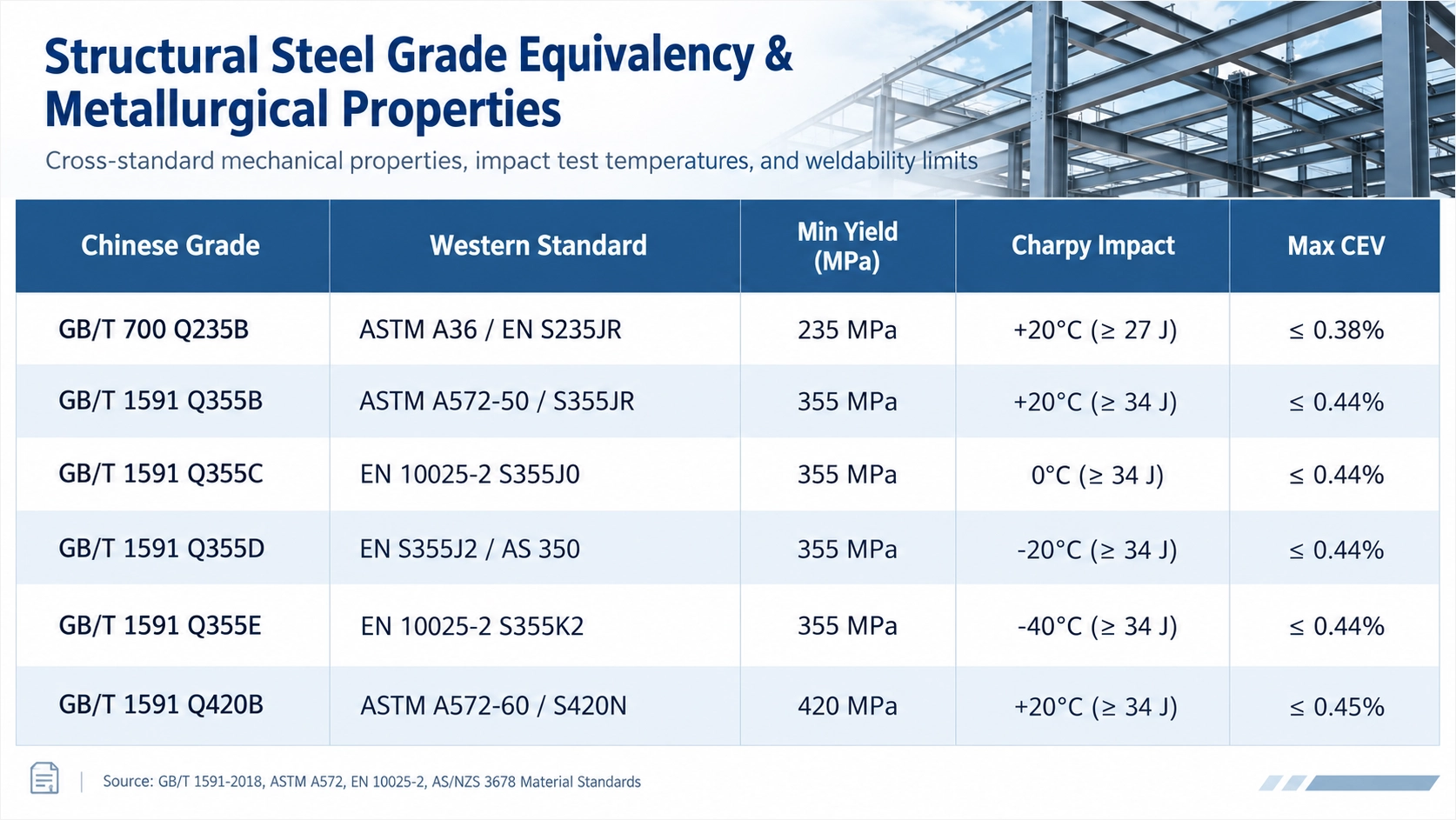
For standard carbon structural applications, Chinese GB/T 700 Q235B is the technical equivalent of ASTM A36, EN 10025-2 S235JR, and AS/NZS 3678 Grade 250. For high-strength low-alloy (HSLA) structural framing, the engineering baseline shifts to the GB/T 1591 standard. GB/T 1591 Q355B specifies a minimum yield strength of 355 MPa (for thickness ≤ 16mm), matching ASTM A572 Grade 50 (345 MPa) and EN 10025-2 S355 (355 MPa).
| Standard Jurisdiction | Specification & Grade | Min Yield Strength (t ≤ 16mm, MPa) | Tensile Strength (MPa) | Elongation A5 Min (%) | Longitudinal CVN Impact Test |
|---|---|---|---|---|---|
| China (GB) | GB/T 700 Q235B | 235 | 370 - 500 | 26 | 20°C (≥ 27 J) |
| USA (ASTM) | ASTM A36 / A36M | 250 | 400 - 550 | 20 | Optional / Project Specified |
| Europe (EN) | EN 10025-2 S235JR | 235 | 360 - 510 | 26 | 20°C (≥ 27 J) |
| Australia (AS/NZS) | AS/NZS 3678 Gr 250 | 250 | 410 - 540 | 22 | Optional / Non-standard |
| China (GB) | GB/T 1591 Q355B | 355 | 470 - 630 | 21 | 20°C (≥ 34 J) |
| China (GB) | GB/T 1591 Q355C | 355 | 470 - 630 | 21 | 0°C (≥ 34 J) |
| China (GB) | GB/T 1591 Q355D | 355 | 470 - 630 | 21 | -20°C (≥ 34 J) [Cold Climate] |
| USA (ASTM) | ASTM A572 Gr 50 | 345 | 450 - 620 | 18 | Optional per ASTM A6 S5 |
| Europe (EN) | EN 10025-2 S355J2+N | 355 | 470 - 630 | 22 | -20°C (≥ 27 J) |
| Australia (AS/NZS) | AS/NZS 3678 Gr 350 | 350 | 450 - 600 | 20 | Project Specified (e.g., L15) |
Charpy V-Notch Impact Toughness & Cold-Climate Performance
Specifying base grades without detailing sub-grade impact properties introduces severe structural risk in low-temperature service environments. The suffix assigned to GB/T 1591 steels (B, C, D, E) designates specific Charpy V-notch (CVN) impact testing temperatures. Sub-grade impact toughness divergence: Q355B is rated at +20°C (≥ 34 Joules), whereas Q355D requires Charpy V-notch verification at -20°C (≥ 34 Joules), making Q355D mandatory for cold-climate projects.
If an engineer permits Q355B in place of Q355D or EN 10025-2 S355J2/K2 for an industrial logistics hub exposed to sub-zero ambient winter conditions, the base metal operates below its ductile-to-brittle transition temperature. Under high dynamic loading, seismic cycles, or thermal contraction restraints, this mismatch triggers rapid brittle fracture failure without warning plastic deformation.
Weldability Controls and Carbon Equivalent Value (CEV)
Weldability governs fabrication speed and connection reliability in the factory. High residual stresses and inappropriate chemical chemistry promote hydrogen-assisted cold cracking in the heat-affected zone (HAZ). Chinese standard steel chemistry under GB/T 1591 is controlled via the IIW (International Institute of Welding) Carbon Equivalent Value formula:
Maximum allowable Carbon Equivalent Value (CEV) must remain ≤ 0.44% per international weldability standards to prevent hydrogen-induced heat-affected zone (HAZ) cracking. For heavy structural plates exceeding 40mm thickness subjected to high structural restraint, our plant limits ladle CEV to ≤ 0.42%. This restriction avoids mandatory high preheat temperatures above 150°C during automated submerged arc welding (SAW) and flux-cored arc welding (FCAW) under AWS D1.1 and EN 1090-2 Execution Class 3 (EXC3).
| Chemical Element / Index | GB/T 1591 Q355B (t ≤ 16mm) | GB/T 1591 Q355D (t ≤ 16mm) | ASTM A572 Grade 50 | EN 10025-2 S355J2 |
|---|---|---|---|---|
| Carbon (C) Max | 0.20% | 0.18% | 0.23% | 0.20% |
| Silicon (Si) Max | 0.55% | 0.55% | 0.40% | 0.55% |
| Manganese (Mn) Max | 1.60% | 1.60% | 1.35% | 1.60% |
| Phosphorus (P) Max | 0.035% | 0.030% | 0.030% | 0.025% |
| Sulfur (S) Max | 0.035% | 0.025% | 0.030% | 0.025% |
| Microalloys (Nb, V, Ti) | ≤ 0.07% Nb, ≤ 0.15% V | ≤ 0.07% Nb, ≤ 0.15% V | Specified combinations | Specified combinations |
| Max CEV (Heat Analysis) | 0.44% | 0.44% | 0.45% (Calculated) | 0.45% |
Mill Test Report (MTR) Verification Protocols
Material receiving inspections enforce a non-negotiable gateway before raw steel plates enter CNC plasma cutting lines (±0.5mm tolerance) or shot blasting bays (ISO 8501-1 Sa 2.5 profile). EN 10204 Type 3.1 Inspection Certificates require full metallurgical heat traceability signed by the manufacturing mill's independent inspection representative.
Our Quality Assurance department executes a four-tier validation procedure on every incoming heat:
- Heat Tag Physical Audit: Inspectors match the primary ladle heat number stamped or stenciled on each mother plate directly against the accompanying Mill Test Report (MTR).
- Optical Emission Spectrometry (OES): Random coupon checks verify chemical concentrations for C, Si, Mn, P, S, alongside grain-refining microalloying elements (Nb, V, Ti).
- Mechanical Tensile and Impact Validation: Tensile testing, yield strength verification, and CVN impact tests at project-specified temperatures are re-checked in an ISO 17025 accredited laboratory whenever third-party supervision is mandated.
- Ultrasonic Testing (UT) for Heavy Plates: Structural connection plates with thickness t ≥ 40mm undergoing through-thickness tension are scanned per ASTM A435 or EN 10160 to confirm the absence of internal laminations, guarding against lamellar tearing during heavy weld shrinkage.
Production Capacity & Factory Machinery Qualification Benchmarks
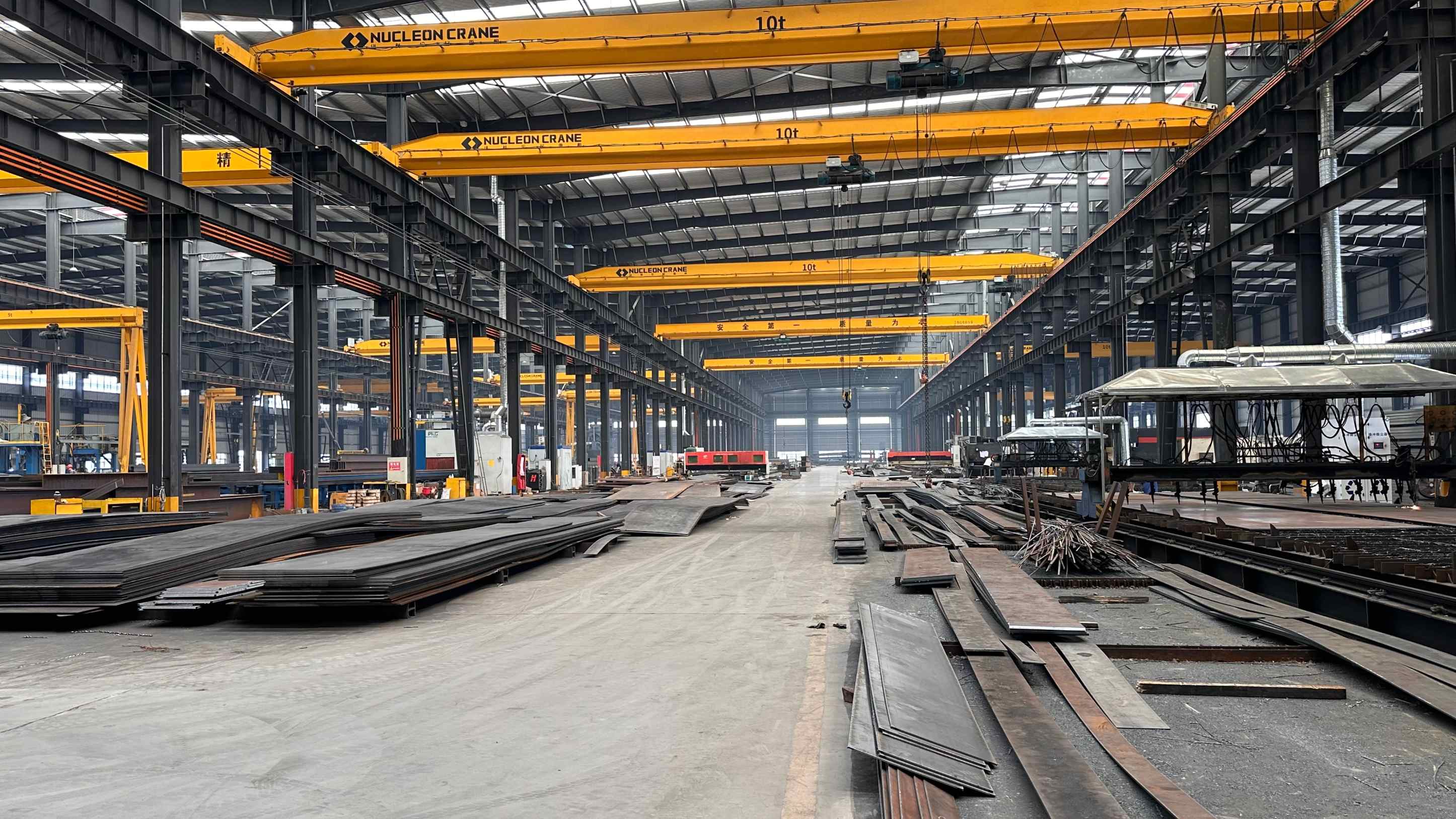
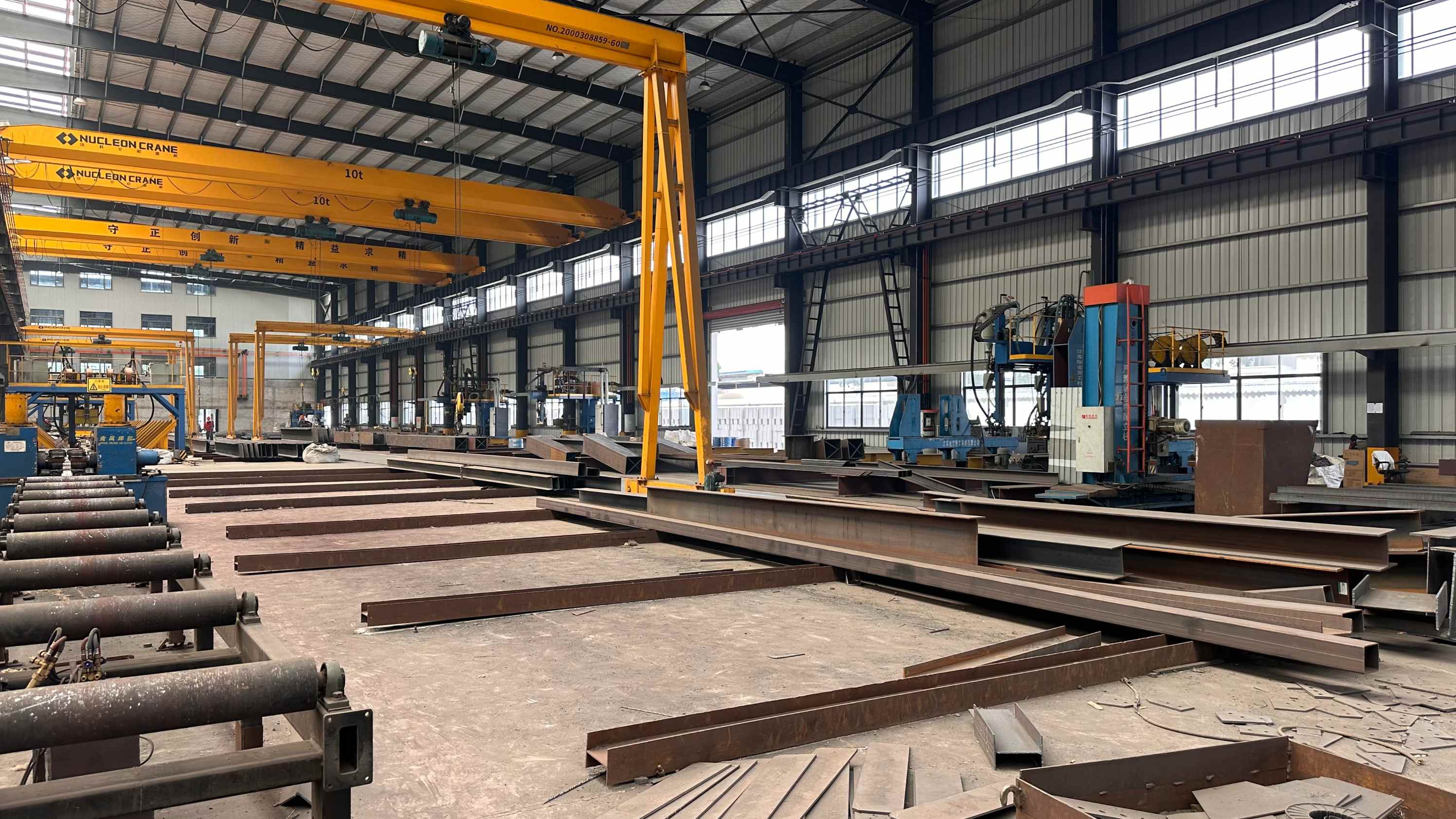
Verifying the operational capacity of a china structural steel factory requires an audit of physical shop-floor assets, automated processing lines, and material handling systems. Low-tier workshops rely on semi-manual layout tools, handheld cutting torches, and labor-heavy assembly tables. These outdated practices induce thermal distortions, erratic weld profiles, and bolt-hole misalignments that stall field erection. In contrast, modern industrial manufacturing facilities standardize on automated, computer-controlled equipment capable of continuous dimensional fidelity. Tier-1 structural steel manufacturing plants operate minimum production footprints of 30,000 m² with sustained fabrication throughput exceeding 3,500 metric tons per month. This production volume provides the capacity cushion needed to absorb large-scale industrial projects without outsourcing work to unregulated secondary sheds.
Shop-Floor Automation and Step-by-Step Workflow Qualification
A compliant heavy structural steel processing sequence moves unidirectionally through automated workstations designed to eliminate cumulative fabrication tolerances:
1. Plate Profiling and Beveling
Raw plate stock (such as ASTM A572 Grade 50 or EN 10025-2 S355JR/J2) must be processed using multi-torch CNC oxy-fuel systems for plate thicknesses exceeding 50 mm, or high-definition CNC plasma cutting lines for thinner plates. Automated CNC plasma and laser cutting lines maintain plate edge beveling and dimensional cut tolerances within ±1.0 mm, eliminating manual grinding fit-up errors. This dimensional precision ensures uniform root gaps during subsequent member assembly.
2. H-Beam Hydraulic Assembly
Fabricated three-plate girders must be assembled on automated H-beam fit-up stations. These machines use heavy hydraulic side-clamping rollers to mechanically center and square the web plate directly against the flange centerlines, holding alignment tolerances within ±1.0 mm while applying automated tack welds.
3. Continuous Submerged Arc Welding (SAW)
Welded built-up sections are transferred to portal or cantilever welding gantries. Tandem-wire Submerged Arc Welding (SAW) gantries operating at 800–1200 Amperes deliver deep penetration fillet welds with minimal angular distortion across heavy H-beam sections. Welding parameters must be qualified per AWS D1.1/D1.1M Table 4.5 or EN ISO 15614-1, matching heat input variables against specified Charpy V-notch toughness targets.
4. Flange Straightening
Post-weld thermal cooling inevitably causes angular flange distortion. High-capacity mechanical hydraulic flange straightening systems apply targeted counter-deflection rollers to restore flange-to-web squareness within the allowable limits of ASTM A6/A6M and AISC Code of Standard Practice (COSP) Section 6.
5. 3D CNC Drilling and Bolt-Hole Alignment
Connection plates, end-plates, and column shafts must avoid manual mag-base drill presses. CNC 3D drilling machines with triple-spindle tool heads ensure connection bolt hole tolerances within ±0.5 mm pitch accuracy, preventing reaming during site erection. Spindles equipped with internal through-tool coolant process flanges and webs concurrently, maintaining exact hole pattern geometry across all three axes.
6. Continuous Shot-Blasting
Structural members enter a heavy roller-conveyor shot-blasting tunnel utilizing multiple centrifugal turbine wheels throwing high-carbon steel shot (S330/S390 blend). Fabricators must achieve an ISO 8501-1 Sa 2.5 cleanliness rating with a consistent surface anchor profile of 40 to 75 microns before moving the steel into temperature-controlled painting bays for primer applications like zinc-rich epoxy systems.
| Processing Stage | Rudimentary Workshop Method | Tier-1 Industrial Benchmark | Engineering Standard / Tolerance |
|---|---|---|---|
| Plate Cutting | Handheld track gas torch | Multi-torch CNC plasma / oxy-fuel | ISO 9013 Class 2, cut tolerance ±1.0 mm |
| Beam Assembly | Manual chalk line, wedge dogging | Automatic hydraulic squaring line | Web-to-flange off-center < 1.5 mm |
| Beam Welding | Manual SMAW / FCAW-S | Twin-wire tandem portal SAW gantry | AWS D1.1 / EN 1090-2 EXC3 |
| Hole Fabrication | Magnetic base drill, hand layout | 3D multi-spindle CNC drill line | Pitch accuracy ±0.5 mm, AISC COSP Sec 6 |
| Flange Camber/Sweep | Torch heating, sledge adjustments | Automatic heavy hydraulic straightener | ASTM A6/A6M, AISC 360-16 |
| Surface Preparation | Manual disk grinding, wire brush | Roller-conveyor wheel shot-blaster | ISO 8501-1 Sa 2.5, profile 40-75 μm |
| Monthly Tonnage | 300 to 800 metric tons | 3,000 to 10,000 metric tons | On-time delivery without subletting |
Production Volume Benchmarks and Subcontracting Risks
Fabrication audits must verify that monthly facility capacity matches the delivery demands of the structural steel package. Tier-1 export fabricators routinely maintain sustained output between 3,000 and 10,000 metric tons per month. When small or mid-tier facilities accept contracts that exceed their shop floor footprint or monthly crane capacity, they frequently subcontract sub-assemblies (such as secondary purlins and trusses) to unvetted third-party sheds. These sub-tier operations often bypass prequalified welding procedure specifications (WPS) and deploy uncertified welders. They also skip raw material inspection protocols, exposing the project to structural failure risks and severe site delays. Engineers auditing overseas facilities should review raw material consumption records alongside total bay hoist capacities, requiring overhead cranes rated at 20 metric tons or higher. Auditing CNC file networking infrastructure confirms that shop personnel cut and weld every structural member within the audited facility before inspection.
Here is what we would check first
Before finalizing layout geometry, evaluate your primary frame deflections, column base moments, and governing lateral wind load coefficients. Operating from our 60,000 square meter fabrication facility, our automated CNC cutting and drilling lines consistently hold sub-millimeter tolerances across all heavy built-up sections.
Structural Welding Certification Protocols: AWS D1.1, EN 1090-2, and WPS/PQR Compliance
Exporting structural steel demands rigorous quality control systems that eliminate the risk of brittle fracture, weld fatigue, and geometric distortion under load. When operating a top-tier china structural steel factory, fabricated components must directly satisfy the project jurisdiction's governing technical code rather than domestic baseline practices. Complete compliance requires an uninterrupted chain of documentation spanning pre-qualified joint design, destructive lab qualification, continuous welder skill verification, and calibrated thermal management during heavy plate assembly.
International structural projects demand qualification under established regional frameworks: AWS D1.1/D1.1M for North American jurisdictions, EN 1090-2 (supported by ISO 3834-2 quality requirements) for the European Union and United Kingdom, and AS/NZS 1554.1 Structural Steel Welding for Australasia. Under European mandates, EN 1090-2 Execution Class 3 (EXC3) is mandatory for dynamically loaded structures, public buildings, and bridges, requiring factory production control (FPC) audit by an accredited Notified Body. Execution Class 2 (EXC2) suffices for standard commercial low-rise buildings, while Execution Class 4 (EXC4) governs high-consequence civic infrastructure and nuclear facilities.
| Structural Welding Standard | Primary Jurisdiction | Execution / Quality Level | Procedure Qualification Basis | Destructive Testing Mandate | Inspection Personnel Benchmark |
|---|---|---|---|---|---|
| AWS D1.1/D1.1M | North America, Global Oil & Gas | Statically / Cyclically Loaded | AWS Clause 4 PQR or Pre-qualified per Clause 3 | Tensile, Root/Face/Side Bend, Macro-etch, CVN if specified | AWS CWI / CAWI under direct supervision |
| EN 1090-2 / ISO 3834-2 | European Union, UK (UKCA) | EXC2, EXC3, EXC4 | EN ISO 15614-1, EN ISO 15613 | Transverse Tensile, Bend, Macro-examination, Charpy V-Notch at design temp | CSWIP 3.1 / 3.2 or IWE/IWT per ISO 14731 |
| AS/NZS 1554.1 | Australia, New Zealand | Structural Purpose (SP), General Purpose (GP) | AS/NZS 1554.1 Section 4 PQR Testing | Tensile, Bend, Charpy Impact, Macro-etch specimen testing | WTIA Welding Inspector / CBIP Certified |
| ISO 3834-2 | International Quality Standard | Comprehensive Quality Requirements | ISO 15607 System Suite | Mandated cross-weld tensile and impact tests per contract | Certified International Welding Technologist (IWT) / Engineer (IWE) |
Welding Procedure Specifications (WPS) must be supported by certified Procedure Qualification Records (PQR) containing mechanical tensile, bend, and macro-etch lab verification. For sub-zero ambient conditions, PQRs must incorporate Charpy V-notch impact tests demonstrating minimum energy absorption thresholds (such as 27 Joules at -20°C per EN 10025 or ASTM A6/A6M). The WPS document acts as the definitive instruction sheet on the shop floor, specifying bevel angles (typically 30° to 45° single or double-V profiles), root faces (1.5mm to 2.5mm), ceramic or steel backing bar configurations, and gas composition. For Flux-Cored Arc Welding (FCAW-G), gas mixes are tightly controlled (commonly an 80/20 Argon/CO2 blend or 100% CO2 per AWS A5.20 E71T-1C/1M specifications) to govern arc stability and spatter generation.
Preheat and interpass temperature controls (typically 65°C to 150°C depending on carbon equivalent and thickness ≥ 25mm) must be monitored using thermal tempil sticks or calibrated infrared pyrometers. Maintaining minimum preheat retards the cooling rate, preventing the formation of brittle martensite phases in the heat-affected zone (HAZ) and driving out diffusible hydrogen. Welding thick flange joints (ASTM A992 or Q355B plates exceeding 40mm) requires continuous multi-pass heat maintenance until the joint is fully welded and covered with insulating thermal blankets to prevent hydrogen-induced cold cracking.
Shop assembly is only as dependable as the individuals executing the passes. Welder Performance Qualifications (WPQ) per AWS D1.1 or ISO 9606-1 expire if the welder has not utilized the specific welding process for six consecutive months. Individual welder identification stamps must accompany every finished structural joint. All complete joint penetration (CJP) column splices, crane rail girders, and moment connections undergo non-destructive examination (NDE) overseen by an independent AWS Certified Welding Inspector (CWI) or CSWIP 3.1/3.2 Senior Welding Inspector. NDE protocols enforce 100% Visual Testing (VT), minimum 20% Magnetic Particle Testing (MT) for shear and fillet welds, and 100% Ultrasonic Testing (UT per AWS D1.1 Clause 6 Part F or EN ISO 17640) on high-stress dynamic joints.
Quality Assurance Protocols: Non-Destructive Testing (NDT) & Dimensional Tolerance Verification
Inside our china structural steel factory, shop fabrication verification follows an exhaustive quality control plan to prevent field erection delays and structural defects before overseas transit. Every fabricated structural member undergoes verified inspection stages covering base metal integrity, weld volumetric soundness, and physical envelope compliance. Quality surveillance starts with 100% Visual Testing (VT) under AWS D1.1 Table 6.1 and EN ISO 5817 Quality Level B, checking for undercut limits (maximum 0.5 mm on primary members), profile transitions, complete joint penetration, and the absolute elimination of surface porosity, arc strikes, and micro-cracks.
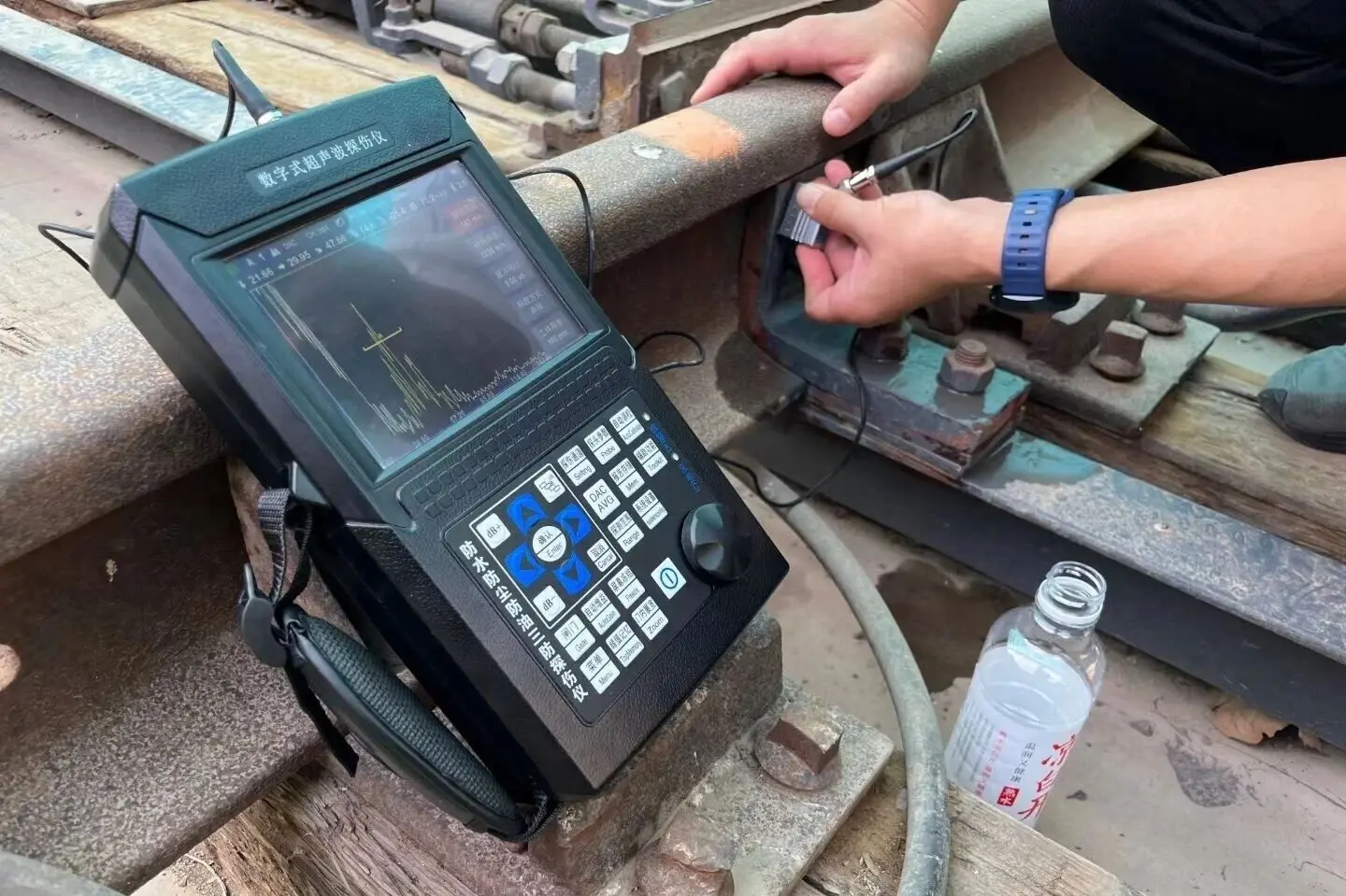
Surface evaluation alone cannot expose internal root flaws or boundary lack of fusion. Complete Joint Penetration (CJP) butt welds require 100% Ultrasonic Testing (UT) per AWS D1.1 Class B/C criteria or EN ISO 11666 Level 2 acceptance thresholds. Straight-beam probes examine raw plates for internal laminations per ASTM A435/A578 before cutting, while angle-beam shear-wave transducers (2.25 MHz to 4.0 MHz calibrated per GB/T 11345 or EN ISO 17640 Level B) interrogate high-stress column-to-beam moment connections and column splices. For heavy fillet welds on crane runway girder brackets, base stiffeners, and transverse web stiffeners, Magnetic Particle Inspection (MPI) detects sub-surface cracks and lack of fusion within 2mm of the weld toe that visual testing cannot resolve. MPI is conducted under ASTM E709 or EN ISO 17638 using alternating current electromagnetic yokes. Where joint geometries restrict angle-beam probe travel, such as boxed-column internal diaphragm corners, Radiographic Testing (RT) per ASTM E94 or EN ISO 17636-1 provides definitive radiographic film or digital detector array verification.
| Inspection Method | Target Joints and Locations | Governing Code / Standard | Acceptance Threshold | Typical Frequency |
|---|---|---|---|---|
| Visual Testing (VT) | All fillet and groove welds | AWS D1.1 Tab 6.1 / ISO 5817 | Quality Level B (Zero crack, undercut ≤ 0.5mm) | 100% all fabrications |
| Ultrasonic Testing (UT) | Transverse and longitudinal CJP butt welds | GB/T 11345 / EN ISO 17640 | EN ISO 11666 Level 2 / AWS D1.1 Class B | 100% CJP joints |
| Magnetic Particle (MPI) | Crane bracket fillets, high-shear connections | ASTM E709 / EN ISO 17638 | ISO 23278 2X / AWS D1.1 Section 6 | 20% to 100% critical welds |
| Radiographic Testing (RT) | Obstructed CJP geometry, beam splice webs | ASTM E94 / EN ISO 17636 | AWS D1.1 Class B / ISO 10675-1 Level 2 | Selective / audit locations |
Dimensional Tolerances: AISC 303 vs. GB 50205 Benchmarks
Geometric control directly governs erection speed on the job site. All shop fabrication complies with the allowable limits specified in AISC 303 (Code of Standard Practice for Steel Buildings and Bridges) and GB 50205 (Standard for Acceptance of Construction Quality of Steel Structures). Computer numerical control (CNC) plasma cutting systems operate within a tolerance envelope of ±0.5 mm, maintaining bolt hole spacing within ±0.5 mm across bolt groups. GB 50205 and AISC standards limit column length tolerances to ±2.0 mm for members up to 9 meters and restrict member camber/sweep deviations to a maximum of L/1000. For members exceeding 9 meters in length, the axial length deviation allows up to ±3.0 mm. Cross-sectional depth and flange breadth are held to ±2.0 mm, while flange out-of-squareness cannot exceed b/100 or 5.0 mm maximum.
| Parameter Description | Member Length / Condition | AISC 303 Standard | GB 50205 Requirement | Factory Shop Benchmark |
|---|---|---|---|---|
| Overall Length (L) | L ≤ 9.0 meters | ± 1.6 mm to ± 2.0 mm | ± 2.0 mm | ± 1.5 mm |
| Overall Length (L) | L > 9.0 meters | ± 3.2 mm | ± 3.0 mm | ± 2.0 mm |
| Camber Deviation | Heavy girders and trusses | ± 6.0 mm from specified | Within L/1000 (max 10 mm) | ± 3.0 mm |
| Sweep Deviation | Portal columns and crane beams | L/1000 (max 10 mm) | L/1000 (max 10 mm) | L/1200 |
| Flange Tilt / Out-of-Square | Beam and column profiles | b/100 or 6.0 mm max | b/100 or 5.0 mm max | b/150 or 3.0 mm max |
| Cross-Section Depth & Width | Built-up H-beams / Box columns | ± 3.0 mm | ± 2.0 mm | ± 1.5 mm |
To guarantee zero misalignment during on-site erection, large-span structures undergo mandatory pre-assembly. Shop trial pre-assembly of 10% to 20% of consecutive framing bays guarantees connection plate matching and hole clearance before structural elements are surface coated. Multi-tier columns, roof truss segments, and crane rail portal bents are systematically aligned in the factory pre-assembly yard using precision drift pins. Once bolt hole clearances and splices verify 100% pin passage without mechanical reaming, components are unbolted and transferred to automated wheel blast cleaning to achieve an ISO 8501-1 Sa 2.5 surface profile with a 45 to 75 μm anchor profile. This process provides an optimal mechanical bond before applying specified primer systems, such as an 80 μm dry film thickness (DFT) epoxy zinc-rich primer.
Protective Coating Systems & Maritime Corrosion Protection (ISO 12944 & ASTM A123)
Trans-oceanic transit presents an aggressive corrosive environment for prefabricated structural steel. Structural members packed into cargo holds or secured on breakbulk decks endure sustained exposure to relative humidity exceeding 85%, chloride-laden sea salt aerosols, and thermal condensation cycles over voyage durations that span 25 to 50 days. At our china structural steel factory, surface preparation establishes the absolute mechanical baseline for long-term coating adhesion. ISO 8501-1 Sa 2.5 blast cleaning with an anchor profile of Rz 40–75 μm is non-negotiable to ensure primer mechanical interlock and prevent delamination. Automated roller-conveyor centrifugal blast machines use a calibrated working mix of steel shot (S280/S330) and angular steel grit (G40/G50) to produce this sharp, multi-faceted profile. Secondary manual blasting touches up reentrant corners, connection gussets, and stiffener plates to guarantee SSPC-SP 10 (NACE No. 2) near-white blast conditions across 100% of the steel surface. Profile amplitude is verified across every shift using replica tape and digital micrometers in accordance with ASTM D4417 Method C.
Coating systems are engineered directly around the macroclimatic operating conditions defined in ISO 12944-2. For aggressive coastal processing plants and offshore support structures categorized under C4, C5, and CX corrosivity bands, liquid protective schedules rely on a tri-layer barrier and sacrificial architecture. Zinc-rich primers must contain a minimum of 80% metallic zinc dust by weight in the dry film per ISO 12944-5 specifications for high-durability protection. This high zinc loading provides active cathodic protection to ASTM A992, ASTM A572 Grade 50, and Q355B base metals, polarizing exposed steel if micro-fissures develop during ocean handling.
The intermediate coat is a high-build two-component polyamide-cured epoxy impregnated with lamellar micaceous iron oxide (MIO) pigments applied at 100 to 150 μm Dry Film Thickness (DFT). The overlapping, plate-like MIO particles settle parallel to the steel substrate, creating a tortuous physical path that impedes the diffusion of moisture, oxygen, and electrolyte ions toward the primer. The exterior weatherable layer comprises an aliphatic acrylic polyurethane topcoat (50 to 70 μm DFT) characterized by high carbon-fluorine or aliphatic urethane bonds that resist severe photochemical degradation, ultraviolet breakdown, and chalking. Total Dry Film Thickness (DFT) across a three-coat industrial paint system for ISO 12944 C4/C5 environments must achieve 240–320 μm inspected per SSPC-PA 2 standards.
| Corrosivity Category | Environment Profile | Blast Cleanliness & Profile | Primer Layer (DFT) | Intermediate Layer (DFT) | Topcoat Layer (DFT) | Total Nominal DFT | Durability Range |
|---|---|---|---|---|---|---|---|
| C3 (Medium) | Urban, light industrial, inland production | Sa 2.5, Rz 40-60 μm | Epoxy Zinc-Rich (60 μm) | High-Build Epoxy (100 μm) | Polyurethane (50 μm) | 210 μm | High (15-25 yrs) |
| C4 (High) | Coastal industrial, chemical processing | Sa 2.5, Rz 50-75 μm | Epoxy Zinc-Rich (75 μm) | Epoxy MIO (125 μm) | Polyurethane (60 μm) | 260 μm | Very High (> 25 yrs) |
| C5 (Very High) | Marine shorelines, splash zones, ports | Sa 2.5, Rz 50-75 μm | Ethyl Silicate Zinc (80 μm) | Epoxy MIO (150 μm) | Polyurethane (70 μm) | 300 μm | Very High (> 25 yrs) |
| CX (Extreme) | Offshore platforms, extreme marine | Sa 2.5, Rz 60-75 μm | Inorganic Zinc-Rich (80 μm) | Phenolic Epoxy (175 μm) | Polysiloxane (65 μm) | 320 μm | Very High (> 25 yrs) |
When clients specify continuous metallurgic bonding instead of liquid barrier films, structural framing elements receive hot-dip galvanizing under rigorous process controls. Hot-dip galvanizing per ASTM A123 mandates an average coating thickness ≥ 85 μm (600 g/m²) for structural steel sections greater than 6.0 mm in thickness. Welded assemblies pass sequentially through hot alkaline degreasing, water rinsing, inhibited hydrochloric acid pickling (8% to 12% concentration), and a heated zinc ammonium chloride flux tank before dipping into a high-grade molten zinc kettle maintained at 445°C to 455°C. Structural shapes with section thicknesses between 4.8 mm and 6.0 mm require an average minimum zinc thickness of 75 μm, while structural base plates and wide-flange columns exceeding 6.0 mm consistently develop metallurgically bonded iron-zinc alloy layers (Gamma, Delta, Zeta, and Eta) yielding total protective thicknesses of 85 μm to 130 μm per ASTM A123 and ISO 1461.
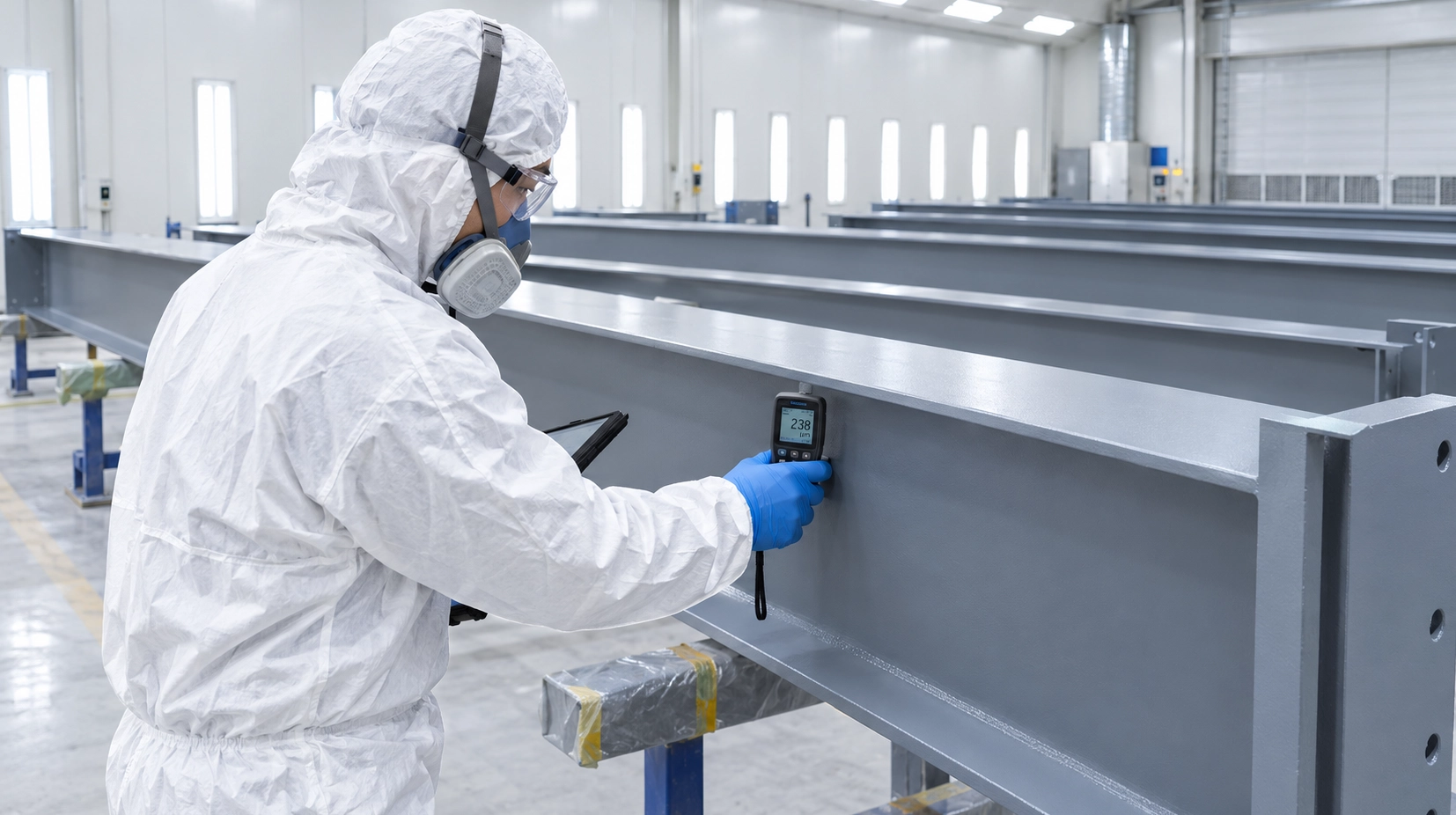
Rigorous QA/QC protocols govern component release prior to factory crating. Paint dry film thickness is evaluated using calibrated electromagnetic dry-film thickness gauges calibrated according to SSPC-PA 2. The shop applies the standard 80-20 rule: no spot reading can register below 80% of the specified minimum DFT, and the average of spot readings within any 10-square-meter inspection area must meet or exceed the specified total thickness. Mechanical adhesion is tested on dedicated production run-off tabs using cross-cut tape testing according to ASTM D3359 Method A (X-cut for films above 125 μm) and ISO 2409, requiring a minimum 4A or Class 1 rating. Slip-critical connection faying surfaces are treated to meet AISC 360-16 Class B performance standards (minimum mean slip coefficient 0.50), shielded from intermediate and polyurethane topcoats, and coated exclusively with unsealed inorganic zinc-rich primers calibrated to 50–75 μm DFT.
Containerized Packaging, Nesting Schemas & Maritime Breakbulk Logistics
Logistical engineering dictates structural geometry long before raw plates reach the CNC cutting table. At Shandong XinQiao Steel Structure Co., Ltd., transport limitations govern the location of field splices, shipping piece weights, and connection details. When procuring fabricated packages from a Chinese structural steel factory, project profitability hinges on volumetric stowage efficiency and the complete prevention of transit-induced mechanical distortion or chemical corrosion.
Standard intermodal ocean containers impose strict dimensional boundaries that require systematic detailing adjustments during the detailing stage in Tekla Structures.
| Shipping Modality | Internal Dimensions (L x W x H) | Door / Clear Opening (W x H) | Max Payload (MT) | Primary Structural Allocations |
|---|---|---|---|---|
| 40ft High Cube (40HC) | 12.03m × 2.35m × 2.69m | 2.34m × 2.58m | 26.5 MT | Nested columns, rafters, secondary purlins, bracings |
| 40ft Open Top (40OT) | 12.02m × 2.34m × 2.38m | 2.34m × 2.28m (Removable) | 26.3 MT | Heavy built-up H-sections, overhead crane runways |
| 40ft Flat Rack (40FR) | 11.65m × 2.44m × 2.21m | Flush deck (Unobstructed) | 40.0 MT | Heavy built-up crane girders, wide box columns, trusses |
| Breakbulk Charter | Vessel hold / tween deck specific | Direct overhead crane hook | Variable (100+ MT) | Out-of-gauge (OOG) trusses >12m length or >2.8m width |
Standard 40HC container door openings restrict member profiles to 2.34m width and 2.58m height, requiring portal rafters longer than 11.8m to incorporate bolted splice joints. Designers must balance the cost of additional field splice plates, grade 10.9 high-strength bolts, and fabrication labor against the ocean freight savings achieved by containerization over breakbulk chartering.
Nesting Schemas and Mechanical Protection Directives
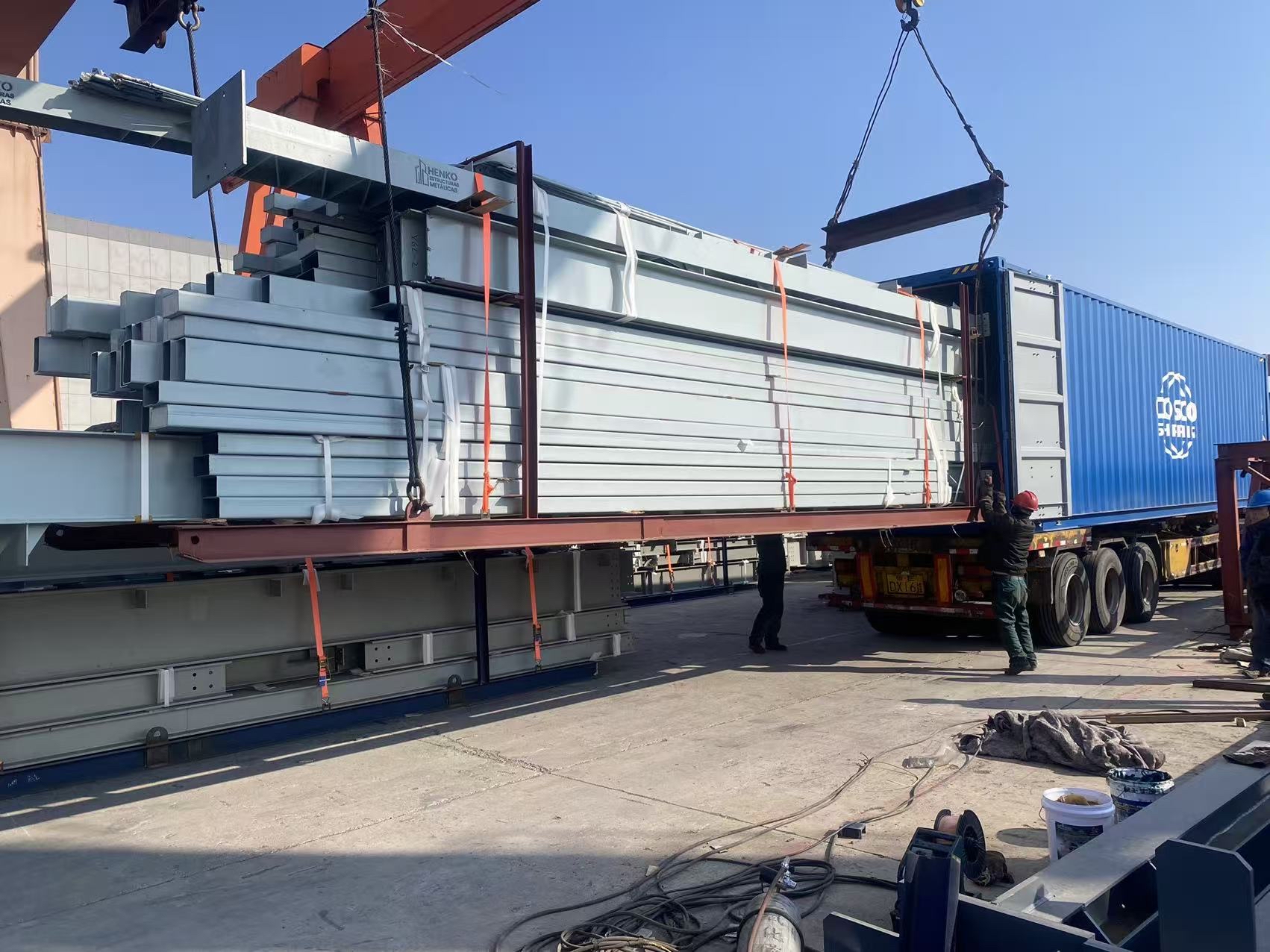
Maximizing container payload toward the 26.5 metric ton limit requires systematic nesting. Unfilled voids in cargo containers represent wasted shipping capital. XinQiao engineering teams develop algorithmic container-stuffing manifests where secondary cold-formed members fit inside primary built-up shapes.
- Nesting Protocols: Continuous C-sections and Z-purlins nest directly within the web channels of primary H-beam rafters and columns. Small components, including gusset plates, connection angles, and base plates, travel packed inside welded steel cages sized to fit within remaining structural cavities.
- Contact Isolation: Direct metal-to-metal contact during dynamic transit causes severe friction scarring that degrades protective paints. Packaging schemas utilizing high-tensile 32mm × 0.9mm steel strapping and EPE foam interleaving prevent friction damage and coating gouging during ocean transit pitch and roll. Neoprene isolation strips separate individual heavy structural members, while polyester edge-protectors sit beneath tensioned steel bands to protect painted flanges.
- Quarantine Compliance: Timber dunnage and wood blocking must bear the IPPC ISPM 15 heat-treatment stamp to prevent port quarantine rejection and biosecurity fumigation penalties. Untreated or improperly marked wood risks total cargo refusal or costly offshore processing delays at destination terminals in North America, Europe, and Australia.
Ocean Transit Preservation and Microclimate Control
Maritime transit through equatorial routes subjects enclosed container volumes to severe temperature swings, which creates cyclic condensation cycles known as "container rain." An enclosed container can experience internal temperature swings from 15 degrees Celsius to over 60 degrees Celsius within a 24-hour cycle, rapidly sweating moisture onto exposed steel.
Calcium chloride desiccants and VCI film barrier wraps prevent moisture condensation and "container rain" during equatorial maritime transits spanning 25 to 45 days. High-capacity desiccant bags containing active calcium chloride (CaCl2) with starch binding agents are deployed at a rate of 2.0 kilograms per 10 cubic meters of container volume. These bags suspend from the internal container ceiling rings without blocking designated ventilation pathways.
For high-specification finish coatings (such as three-coat systems consisting of 80 microns zinc-rich epoxy, 100 microns epoxy micaceous iron oxide, and 60 microns polyurethane finish per ISO 12944), complete bundles undergo automated encasement in high-strength Vapor Corrosion Inhibitor (VCI) shrink film. This creates a sealed microclimate that actively neutralizes ionic oxidation on unpainted surfaces, such as pre-machined connection faces and weld-prep bevels.
Breakbulk and Out-of-Gauge (OOG) Heavy Lift Directives
When structural spans require non-segmented girders or pre-assembled 3D lattice trusses exceeding 12.0 meters in length or 2.8 meters in shipping width, breakbulk chartering becomes mandatory.
Fabrication for breakbulk loading requires integrated maritime rigging connections designed directly into the steel components. Welded lifting lugs, designed per AWS D1.1 structural welding requirements and AISC provisions for lifting hardware, incorporate clearly marked centers of gravity (CoG) and gross weights stenciled in high-contrast marine-grade industrial paint.
Lashing brackets must resist longitudinal inertia loads of 0.5g and transverse inertia loads of 0.8g, matching the structural acceleration criteria established in Annex 13 of the IMO Code of Safe Practice for Cargo Stowage and Securing (CSS Code). This unified focus on engineering, packing, and maritime chemistry ensures that steel components manufactured in our workshops arrive at international jobsites within specified geometric tolerances (±2mm member straightness) and retain complete coating integrity ready for immediate erection.
Commercial Procurement Framework: Pricing Models, Payment Escrows, and RFQ Specifications
Procuring prefabricated steel framing from an overseas manufacturer requires an unbundled pricing structure to prevent hidden margin padding and commercial scope creep. When contracting with a china structural steel factory, general contractors and EPC firms must decouple raw material market movements from workshop processing rates. Base steel pricing should tie directly to transparent commodity indices, specifically the Shanghai Futures Exchange (SHFE) hot-rolled coil (HRC) and rebar settlement prices, or the Shanghai Metal Market (SMM) heavy plate index for Q355B and ASTM A572 Grade 50 equivalents.
The true delivered price per metric ton breaks down into four quantifiable cost centers: raw steel plate purchase cost, workshop fabrication conversion, corrosion protection application, and containerized logistics handling. Structural steel fabrication conversion costs range from $280 to $480 per metric ton over raw plate spot prices, depending on welding joint complexity and member connection density. Built-up plate girders with simple fillet welds sit at the lower end of this conversion range, whereas complex lattice trusses with full-penetration complete joint penetration (CJP) multi-pass welding, heavy stiffener arrays, and tight CNC end-milling tolerances demand the upper threshold. Protective coating costs add $120 to $250 per metric ton depending on whether the specification calls for a standard three-coat epoxy-polyurethane system applied over ISO 8501-1 Sa 2.5 blast cleaning, or heavy batch hot-dip galvanizing according to ASTM A123 / ISO 1461. Finally, internal container stuffing, customized dunnage fabrication, flat-rack lashing, and port handling fees add $40 to $75 per metric ton at deepwater terminals such as Qingdao or Tianjin.
| Structural System | Base Material Benchmark | Conversion Cost (USD/MT) | Surface Coating (USD/MT) | Port Stuffing (USD/MT) | Total Indicative FOB (USD/MT) |
|---|---|---|---|---|---|
| Standard Portal Rigid Frames | SHFE HRC / Q355B Spot | 280 - 340 | 120 - 150 (Sa 2.5, 120μm Epoxy) | 40 - 55 | 980 - 1,180 |
| Crane Girders & Heavy Columns | SMM Medium Plate / Q355C | 330 - 410 | 140 - 180 (Sa 2.5, 160μm Epoxy) | 45 - 60 | 1,080 - 1,320 |
| Complex Pipe Trusses & Space Frames | Seamless Pipe / Q355B Spot | 390 - 480 | 180 - 250 (Hot-Dip Galv ≥85μm) | 55 - 75 | 1,250 - 1,550 |
| High-Rise Moment Connections | Heavy ASTM A992 / Q355D | 360 - 460 | 150 - 210 (Sa 2.5, 240μm Fluorocarbon) | 50 - 70 | 1,190 - 1,470 |
Milestone Payment Escrow Governance
Securing capital during fabrication requires abandoning aggressive advance payment terms. Under no circumstances should an international buyer issue 100% upfront telegraphic transfers (T/T). Instead, enforce a rigorous milestone payment escrow linked directly to physical quality verification gates:
- ▪ Advance Mobilization Deposit (30%): Released only upon receipt of a formal Advance Payment Guarantee (APG) issued through a major international bank. This capitalizes raw material purchasing from verified primary mills like Baosteel or HBIS.
- ▪ Material Processing Milestone (40%): Released after the factory receives raw plate, issues EN 10204 Type 3.1 Material Test Reports (MTR) matching heat numbers on the steel, and finishes automated CNC primary cutting, drilling, and plasma beveling (within standard ±0.5mm cutting tolerances).
- ▪ Factory Acceptance Gate (20%): Released strictly post-NDT and pre-shipment third-party inspection sign-off. Letter of Credit (L/C at sight) or milestone-based T/T retaining 30% until third-party pre-shipment inspection sign-off protects EPC buyers against non-conforming structural shipments. Independent third-party inspection (TPI) services by agencies like SGS, Bureau Veritas, or TÜV Rheinland cost approximately 1.5% to 3.0% of total order value but reduce defect claims by over 90%.
- ▪ Commercial Retention (10%): Held either as an open account retention released against final clean-on-board bills of lading (BOL), or managed via an Irrevocable Letter of Credit (L/C at sight) drawn on a Tier-1 international bank.
Tender Package & RFQ Specifications
A complete structural RFQ package must include 3D IFC/Tekla structural models, an explicit fabrication code matrix, and coating DFT tolerances to prevent change-order cost inflation. Relying merely on 2D architectural PDFs invites catastrophic scope gaps. The tender package must stipulate native Tekla models or native 3D IFC files containing member profile cross-sections, connection node designs, shear tab configurations, and bolt grades (ASTM A325, A490, or ISO 8.8/10.9).
The RFQ must declare the governing execution standard upfront: AWS D1.1 for North American projects or EN 1090-2 (Execution Class EXC2, EXC3, or EXC4) for European standards. The scope must clearly set the required non-destructive testing (NDT) percentages across all structural members, such as 100% ultrasonic testing (UT) on transverse CJP welds, 20% magnetic particle testing (MT) on shear tabs, and 100% visual inspection (VT). Finally, establish packaging specs, including wooden dunnage isolation to avoid metal-to-metal gouging, bundle weight limits under 3.5 metric tons per bundle for open-top containers, and dry film thickness (DFT) gauges calibrated per SSPC-PA 2 to prevent costly rework at the job site.
Conclusion
Procuring prefabricated structural steel from China delivers substantial capital and schedule advantages when supported by uncompromising quality governance. Navigating the market requires shifting from speculative brokered bidding to rigorous direct OEM audits: validating registered business scopes, verifying blast-furnace mill contracts with EN 10204 Type 3.1 certificates, inspecting shop-floor automated CNC and tandem SAW lines, enforcing AWS D1.1 or EN 1090-2 EXC3 welding qualifications, and specifying certified multi-coat corrosion barriers. By establishing definitive RFQ parameters and milestone-gated payment escrows, international EPC contractors ensure fabricated framing kits arrive on job sites with zero dimensional misalignment, complete coating integrity, and certified structural performance ready for immediate erection.
Talk to a specialist
Direct communication between your project engineers and our production team resolves structural discrepancies before steel detailing and cutting commence. We review your structural member schedules, crane runway requirements, and welding details for adherence to AWS D1.1 and international execution classes.
Moment-resisting haunch connections must satisfy AISC 360-16 and Design Guide 1 criteria. Foundation anchor rods must resolve lateral horizontal thrust via hairpin rebar or tie rods whenever base thrust exceeds 85 kN per footing.
Governing References & Standards
Structural design criteria, material specifications, and quality verification standards cited in this engineering manual:
AISC Design Guide 1: Base Plate and Anchor Rod Design (Second Edition)
Fisher, J. M., & Kloiber, L. A. (American Institute of Steel Construction, 2006).
ACI 318-19: Building Code Requirements for Structural Concrete
Chapter 17: Anchoring to Concrete. American Concrete Institute (2019).
ASTM F1554-20: Standard Specification for Anchor Bolts, Steel
36, 55, and 105-ksi Yield Strength. ASTM International (2020).
AISC 303-22: Code of Standard Practice for Steel Buildings and Bridges
Section 7.5: Anchor Rods and Foundation Bolting. AISC (2022).
EN 1993-1-8: Eurocode 3: Design of steel structures
Part 1-8: Design of joints. European Committee for Standardization (CEN) (2005).
EN 1992-4: Eurocode 2: Design of concrete structures
Part 4: Design of fastenings for use in concrete. CEN (2018).
EN 1090-2: Execution of steel structures and aluminium structures
Part 2: Technical requirements for steel structures. CEN (2018).
ISO 898-1: Mechanical properties of fasteners made of carbon steel
Fasteners and alloy steel specifications. ISO (2013).
Upstream Precision: How XinQiao Steel Eliminates Site Erection Headaches
The smoothest construction projects are those where the risk of field error is engineered out long before steel leaves the fabrication plant. When building in remote overseas destinations where specialized heavy equipment and certified rigging crews are expensive, prefabricated structural components must fit together seamlessly upon arrival.
Operating a 60,000 ㎡ heavy industrial steel manufacturing facility in Taian, China, XinQiao Steel (Shandong XinQiao Steel Structure Co., Ltd.) solves overseas assembly challenges at the fabrication source: